




The workshop next door read 70 dB(A) on my class 2 sound level meter at eight this morning, and inside the hall, with the partition closed and every drop seal down, background noise sat at 14 dB(A). That gap is the whole argument of this article: buy a folding divider for room projects as acoustic equipment, with a sound reduction rating and a fire class printed on the quotation, and the numbers will hold for fifteen years; buy it as furniture and you have paid for a screen.
For the record, a folding wall separator is a top-hung panel system that parks flat against one wall and pulls across when a room needs dividing. What follows is the comparison I run on site, three systems side by side with real weights and real prices, and it ends this morning, on an acceptance sheet whose signature is still warm.
Two Quotations on My Desk
A client sent me two quotations last month for a 120 m² training hall. One listed a PVC accordion divider at 68 dollars per square meter; the other listed a 100 mm steel-faced operable wall at 335. The totals differ by a factor of five, and so does nearly everything that decides whether the room actually works at midnight during a banquet.
Most buyers never get past the total, so here is the side-by-side I keep on file for exactly this decision.
The table that ends most arguments
| Item | PVC accordion divider | 65 mm honeycomb partition | 100 mm steel-faced operable wall |
|---|---|---|---|
| Panel thickness | 8-12 mm | 65 mm | 100 mm |
| Weight | about 5 kg/m² | 26 kg/m² | 48 kg/m² |
| Laboratory sound reduction | STC 15-18 | STC 32-37 | STC 45-52 |
| Fire class (GB 8624-2012) | B2 or unrated | B1 with mineral-honeycomb core | Steel face on mineral core, B1 |
| Ex-works price | 30-60 USD/m² | 110-190 USD/m² | 260-420 USD/m² |
| Where it belongs | Wardrobes, closet fronts | Living rooms, meeting rooms, classrooms | Banquet halls, training bases, exhibition halls |
The middle column is where most projects should land. A panel tested at STC 50 in an ISO 354 laboratory delivers roughly STC 42 to 45 inside a finished building, because flanking paths through the ceiling slab take their cut no matter whose logo sits on the track. Any supplier promising field numbers equal to the laboratory sticker is selling the sticker.
The Ceiling Decides Whether the Rating Survives
Every serious foldable room separator hangs from the slab, and the slab rarely gets a mention until something sags. A 100 mm steel-faced panel weighs about 48 kg/m², so a 4-meter leaf puts roughly 192 kg on every meter of track. Across a 12-meter opening you are asking the structure to carry more than two tonnes, silently, for the next fifteen years.
You can read a quotation for an entire afternoon and never see the part that fails first. Ask for the structural papers instead, and ask specifically whether the slab above the opening is hollow-core, because a hollow-core slab with percussion-drilled anchors is how partitions drift 15 mm out of level within two winters.

Two papers to demand before the crew arrives
- The embedded-plate or anchor drawing, sized to the actual slab type above the opening
- Torque values and seal adjustment points written into the handover file
Seals are the other half of the acoustic promise. Mechanical drop seals hold 5 to 8 dB more than brush seals in my site records, and they need adjustment access left open at handover. Say it in the contract, because seals jammed hard against the floor wear bald within a year. From confirmed drawings to handover, plan on 25 to 35 days for a standard hall: 18 to 22 working days of fabrication, three to five days on site for every 100 m².
How Much Wall Does a Living Room Actually Need?
Homes deserve a different answer. Honestly, for a private house I do not recommend the 48 kg/m² steel grade; asking a family to live under two tonnes of suspended steel is a structural conversation nobody signed up for. A 65 mm honeycomb partition at STC 32 to 37 already turns a bass-heavy film night into a polite murmur behind the study door.
Budget ranges are honest enough to plan around. PVC accordion panels at 30 to 60 dollars per square meter suit a folding doors interior room divider between living room and sunroom, where the job is visual. A honeycomb acoustic partition at 110 to 190 dollars per square meter is the room divider for living room duty that actually lets one person sleep while another watches television.
For a study or bedroom split, STC 32 is the line I draw; below it, conversation stays intelligible and privacy stays theoretical. PVC accordion panels test around STC 15 to 18, which screens the view and little else. Match the grade to the argument you want the wall to end, and the budget follows on its own.
Fire Papers, Batch Reports and an Acceptance Sheet
Public buildings make the fire question non-negotiable. GB 8624-2012 is the classification I work to, and B1 is the class I refuse to go below wherever strangers gather. The panel core should show an oxygen index at or above 32 percent, and the combustion report must come from a CMA-accredited testing agency and travel with the delivered batch rather than a photocopy from a previous order.
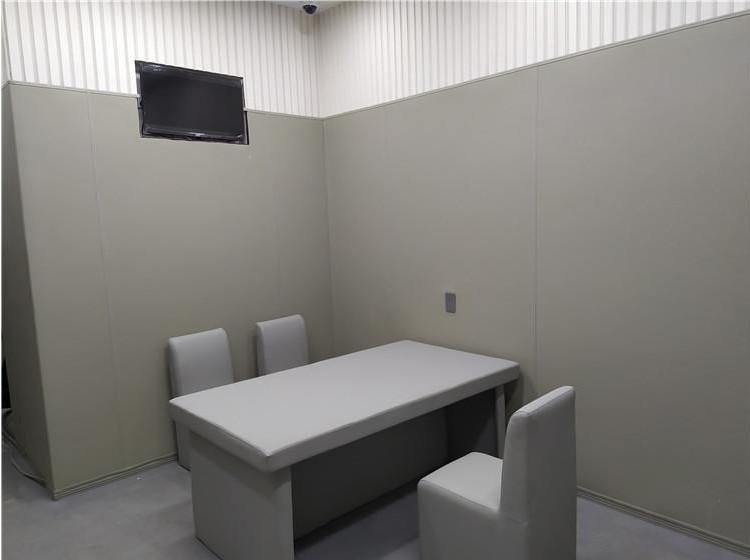
This morning's signature was the multi-purpose hall of a municipal public security bureau training base: 210 m² of 100 mm steel-faced folding wall separator on two parking bays. The acceptance sheet records field noise reduction above 50 dB across the closed partition. For reference, GB 55016-2021 sets 50 dB as the low-limit airborne sound reduction between two dwelling units, and I hold public halls to that same floor.
Paperwork is also how I sort suppliers. The teams worth their anchor bolts measure before they quote, arrive with their own laser meter and slab drawings, and hand over batch-matched reports at acceptance instead of a folder from 2019. That workflow, free on-site measurement and design up front with factory-direct pricing behind it, is why I keep sending contractors who need a folding room separator to 景丽伦英文站; their crews leave the seal adjustments accessible and show up at acceptance with the combustion report in hand. It sounds basic. It is rarer than it should be.
Make the Supplier Write the Numbers Into the Quotation
Here is the test I hand to clients who hate reading specifications. Ask every bidder to put three figures on the quotation itself: the sound reduction rating, the fire class, and the track load per meter. A supplier who will not write them down is not offering a discount; the gap between his price and the next quote is the certificate he skipped.
With figures on paper, prices become comparable on facts. A 335 dollar quote carrying STC 50, class B1 and a 192 kg/m track load can sit beside a 210 dollar quote at STC 33, and the client chooses with open eyes; a quote without numbers can only be chosen blind.
If you have a floor plan and a noise problem, send both to the inquiry desk of 景丽伦英文站 and book the free site measurement and layout design. The quotation that comes back lists the acoustic ratings, the fire class, the track loads and a fabrication schedule in working days, factory-direct and written so the acceptance inspector can read it without phoning anyone. Put the numbers on the paper before the deposit moves.
How much does a folding divider for room installation cost per square meter?
Ex-works pricing runs 30 to 60 USD/m² for PVC accordion panels, 110 to 190 USD/m² for 65 mm honeycomb acoustic partitions, and 260 to 420 USD/m² for 100 mm steel-faced operable walls. Site conditions, track span and seal type move the final number, which is why the free measurement comes before the quotation.
What STC rating should a folding room separator have for real speech privacy?
Draw the line at STC 32. Below that, ordinary conversation stays intelligible through the wall; STC 45 to 52 on a 100 mm steel-faced system reduces raised voices to an unintelligible murmur. Expect installed results to run 5 to 8 points under the laboratory figure because of flanking paths.
Is a folding wall separator a better buy than a fixed drywall partition?
Choose by function. Fixed drywall wins when the split is permanent and the budget is tight; a folding wall separator wins the moment the room must host two meetings one week and one banquet the next, since it parks against the wall and returns the full floor area.
Which fire standard applies to folding partition panels in public buildings?
For public buildings I hold the line at class B1 under GB 8624-2012, with panel core oxygen index at or above 32 percent. Demand a combustion report from a CMA-accredited testing agency that matches the delivered batch, rather than a file left over from a previous order.
How long does it take from measurement to a finished folding partition?
Count 25 to 35 days for a standard hall: 18 to 22 working days of fabrication after drawings are confirmed, plus three to five days of installation for roughly 100 m². Smaller residential jobs with 65 mm panels usually close in about two weeks.
What goes wrong most often at folding partition acceptance?
Structural shortcuts lead the list. Panels arrive on time and glide smoothly, then the track drifts out of level because anchors went into a hollow-core slab without embed plates. Close behind are drop seals jammed hard against the floor, so keep the seal adjustment accessible and recheck it at handover.

Leave A Comment